
OptiVolt · for DSOs and TSOs
Keep voltage in limits. Host more solar.
OptiVolt turns the PV and battery inverters already connected to your network into a coordinated voltage-control resource — computing optimal volt-var settings from your network model.
1.065 → 1.012 p.u.
Overvoltage node near PV restored within ±5%
3 → 19 of 19
Transmission busbars brought inside ±5%
−21%
Active power losses on the Elia–TenneT model
76 s
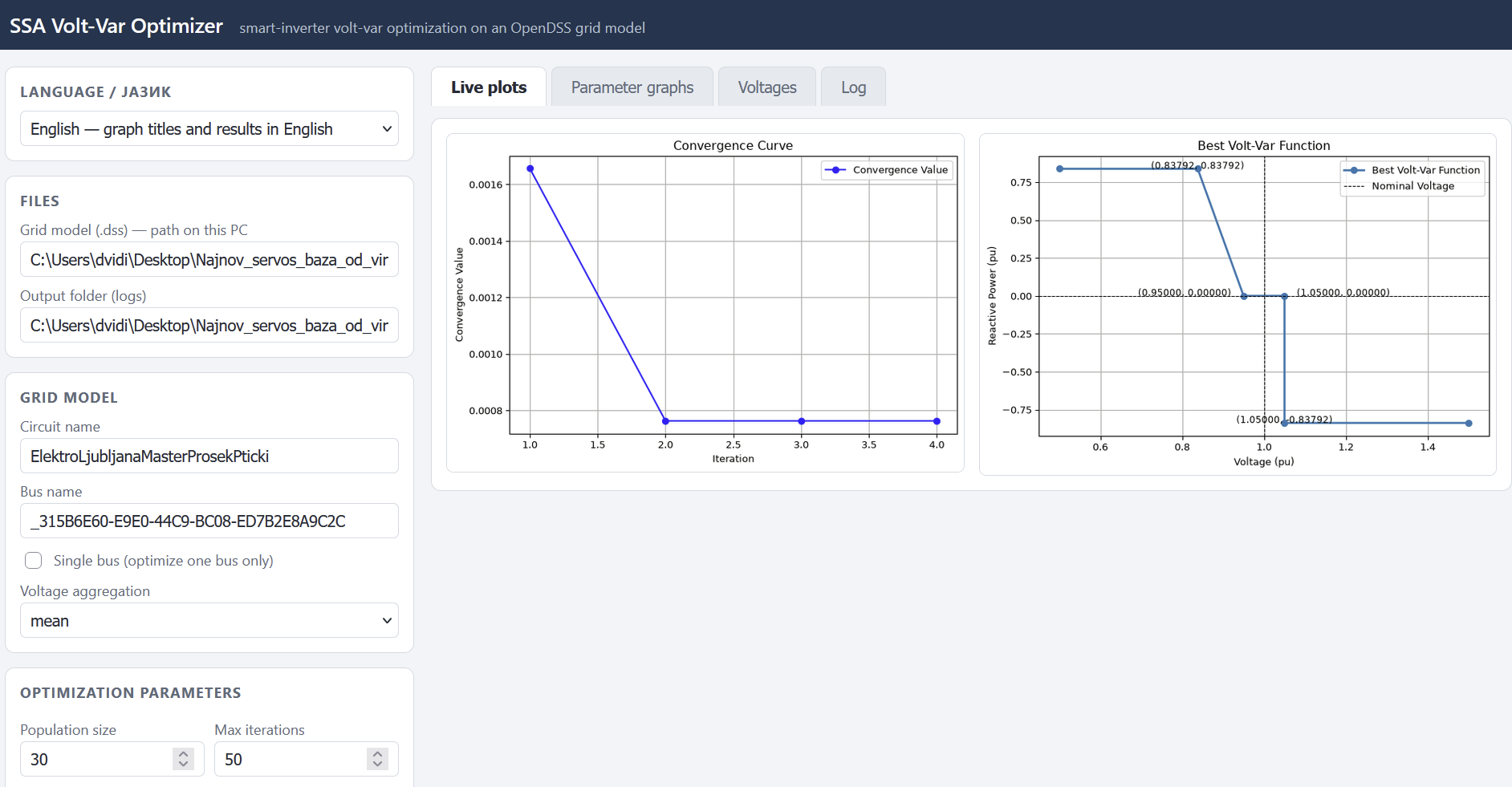
Full optimisation of a 1,616-node network on an office PC
The challenge
Solar is outpacing networks built for one-way flow.
01
Voltage rise on PV feeders
Midday voltage climbs past EN 50160 limits, inverters trip and new connection requests stall.
02
Costly reinforcement
New lines and reactors are the default answer — capital-intensive and slow to deliver.
03
Losses & reactive power
Technical losses and excessive reactive exchange add cost at every voltage level.
04
TSO–DSO coordination
Transmission operators increasingly need DSO-side remedial action for voltage control.
What OptiVolt delivers
A software answer before a copper answer.
OptiVolt coordinates inverter reactive power with tap changers and capacitor banks, then measures the result. It uses standard protocols — IEEE 2030.5, SunSpec and IEC 61850 — and works across vendors.
How it works →- Fewer voltage-limit violations
- More PV hosted on existing feeders
- Deferred network reinforcement
- Lower technical losses
- Controllable reactive exchange with the TSO
- No new equipment, vendor-neutral
Pilot partners
Test OptiVolt on your own feeders.
We are looking for distribution and transmission operators to co-create a four-month pilot — from network model and baseline to optimised settings and verified results.